Chiesa di Sant' Eufemia
What to see
### History
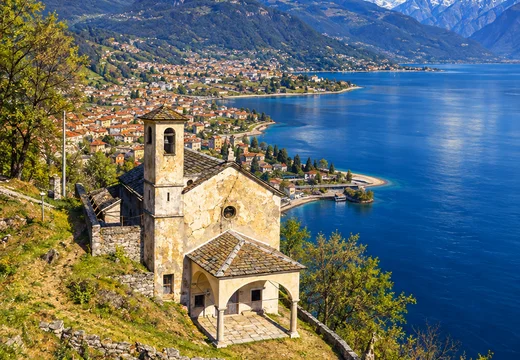
Perched on the scenic Sasso di Musso, the Church of Sant’Eufemia holds centuries of history. Its origins are uncertain, but the building is documented as early as the 15th century and was likely originally dedicated to Saint Childeric.
The small church was part of the great fortress of Gian Giacomo Medici, known as *il Medeghino*, which dominated this part of the lake. In 1532, during the battles that led to the destruction of the castle, it suffered severe damage. In 1593, Bishop Ninguarda described it as already in ruins. It was rebuilt in the 17th century: the date **1662** is still engraved on the façade.
### Art and Architecture
The church is a small single-nave oratory, with a quadrangular presbytery, a bell tower, and a charming porch supported by two marble columns.
On the façade, ancient inscriptions, fragments of worked marble, and two carved crosses beside the portal are preserved, testifying to the long history of the place.
Inside, there is an altar made in 1948 with the precious marble from the quarries of Musso, while the roof is covered in slate from Val Malenco.
### Curiosities and Legends
**The saint who crossed the lake.** According to an ancient legend, Eufemia was a woman from Sueglio, in Val Varrone, who was shunned by her fellow villagers. She miraculously crossed the lake, cutting through the waters with a saw, and settled on the cliff of Musso, from where she could still see her hometown.
**The bell without a bottom.** During her crossing, Eufemia lost a small bell in the deep waters of the lake, exclaiming: "Descend, descend, for you will never touch the bottom!" Tradition says that during storms, its chimes can still be heard. A statue of the saint retains the curious attribute of the saw.
**The contested church.** For centuries, Musso and Dongo vied for the little church. A legend tells that the inhabitants of Dongo would move the entrance door towards their village at night, but every morning they would find it facing Musso again. Even today, while it is linked to the community of Musso, the church is located in the municipal territory of Dongo.
**The Garden of the Blackbird.** On the rocks below, in the 19th century, an extraordinary panoramic garden was created with exotic plants, caves, little bridges, and paths suspended above the lake, once a famous tourist attraction.